

This analytical report, made with the assistance of AI, accompanies the case described in the 4th article of this series: “The True Measure of Fair Play: Spain, the double champion of the 2026 World Cup.”
Case Summary
This report evaluates the performance of the 48 teams that competed in the FIFA World Cup 2026 and presents the team that, applying the CIFP’s analytical framework in its football-specific extension, I consider deserving of Fair Play recognition: Spain.
This report’s starting point is the Fair Play Award FIFA gave to the Netherlands at the close of the tournament, based on the raw disciplinary card count across all 48 teams. This report does not question the accuracy of that count, only its sufficiency as a measure of Fair Play. In fact, as detailed further below, when the disciplinary record is normalized by minutes or matches played, Norway — which played through the quarterfinals — comes out ahead, and Spain — which won the title and played twice as many matches — achieved an index just as remarkable as the Netherlands’.
From that starting point, the rest of this report focuses on Spain’s case —eight matches, from the group stage to the title— evaluated as a candidate for Type 2 (Virtuous Competitiveness / Areté): a pattern of character sustained across a complete competitive process, under mounting pressure and against opponents of mounting quality.
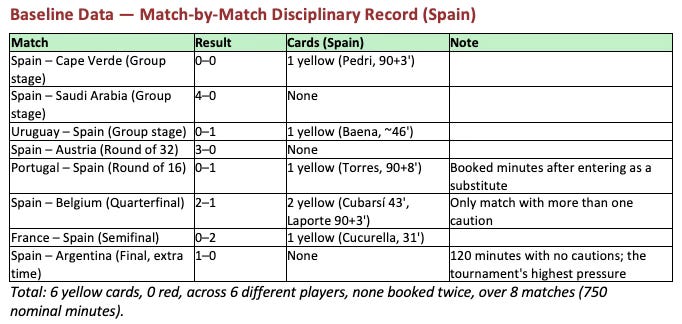
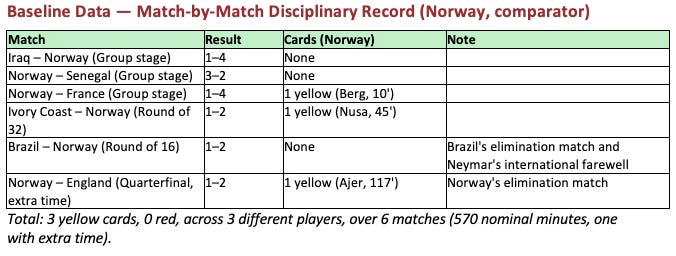
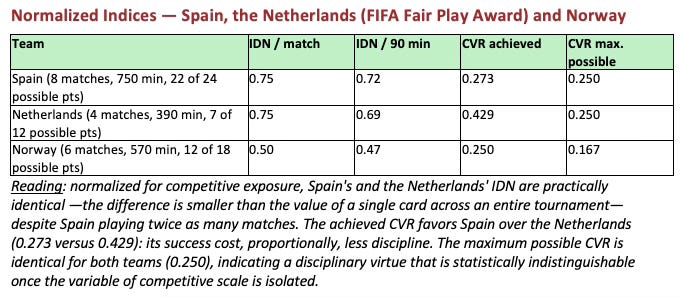
Norway shows the lowest record of the three teams on every index —including a maximum possible CVR (0.167) better than both Spain’s and the Netherlands’— the result of a six-match run that included eliminating Brazil in the round of 16 before falling to England in the quarterfinals. I consider that record, and the sportsmanship gestures that accompanied it —including the warm reception its fans gave the eliminated team, without reproach— to constitute a genuine, well-documented case in its own right. Fan conduct does not correspond to a variable of its own within the current framework, but I record it here as additional evidence for Variable 9 (Symbolic Impact), insofar as a team’s character appears, at least in this case, to project onto the culture of support around it.
However, Norway’s competitive exposure —six matches, 12 of 18 possible points— does not reach Spain’s, and its run did not include a test equivalent to the final: the match of greatest pressure, greatest scrutiny, and greatest risk of character erosion in the entire tournament. It is that combination of scale, pressure, and consistency sustained through to the decisive match that I consider decisive in distinguishing Spain’s case as the most complete of the tournament, without that diminishing Norway’s record.
In this sense, Spain’s case illustrates areté not as the absence of challenge, but as the character that reveals and sustains itself precisely through an agonistic escalation of mounting difficulty —more matches, tougher opponents, greater pressure— all the way to the very limit of the competition: the final. It is in that context, and not one of lesser demand, where Virtuous Competitiveness reaches its fullest expression.
Full methodology, including the scoring convention for knockout matches decided on penalties, in the Appendix: Extension of the Analytical Framework for the Evaluation of Football at the FIFA World Cup. See also the Indicator Legend at the end of this report.
Analytical Note
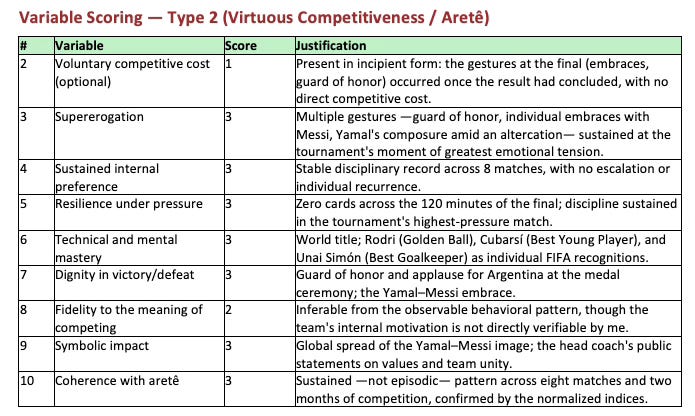
Under the CIFP framework’s eligibility criteria, this case does not meet the requirements for the Pierre de Coubertin Award (Type 1 — Fair Play Act), which requires a voluntary interpersonal moral choice, with a real competitive cost, directed at a specific rival, referee, or official. None of the gestures observed —the guard of honor, the embraces, Yamal’s composure— unambiguously meets that condition of direct competitive cost, since they occurred after the result had already been decided.
The case does solidly satisfy the criteria for Type 2 (Virtuous Competitiveness / Areté). Since this is the first case I have evaluated in the specific context of a FIFA World Cup, I propose that the corresponding recognition —football’s equivalent of the Jean Borotra Award— be named the Bobby Moore Trophy, for the reasons I explain in the following section. Spain’s case meets its criteria with character expressed and sustained across a complete competitive process —not an isolated instant— with consistently high core scores in resilience, dignity, technical mastery, and coherence with areté. The voluntary competitive cost variable, optional for this type, I have deliberately kept low (1) so as not to force a Type 1 reading that the facts do not rigorously support.
Naming Proposal: The Bobby Moore Trophy
As this is the first case I have evaluated under the CIFP’s philosophical framework in the specific context of a FIFA World Cup, I propose giving the Type 2 (Virtuous Competitiveness / Areté) recognition a proper name for football —equivalent to the Jean Borotra Award in the Olympic sphere, but anchored in a historical figure from this sport.
In the absence of an equivalent official recognition, and should an agreement with FIFA become possible, I suggest naming a Fair Play award after Sir Bobby Moore, captain of England’s 1966 World Cup-winning team, for three concrete reasons.
First, the episode known as the “Bogotá Bracelet”: days before the 1970 Mexico World Cup, Moore was falsely accused of stealing a bracelet from a jewelry shop in Bogotá, arrested, and placed under house arrest. He maintained his composure throughout the process, was cleared for lack of evidence, and his own teammates gave him a guard of honor when he rejoined the squad. It is, in itself, a case of dignity under unjust pressure —a demonstration of character in adversity, not in victory.
Second, the shirt exchange with Pelé after the England–Brazil match at that same World Cup: one of the most enduring images in football history, a symbol of mutual respect between rivals at the highest level of competitive demand. Pelé would later describe Moore as “a friend, as well as the greatest defender I ever played against... a real gentleman.” The gesture itself anticipates, with striking historical precision, the Lamine Yamal–Messi scene analyzed in this report.
Third, the absence of institutional controversy in his legacy. I also examined Sir Stanley Rous, FIFA’s legendary former president and a founder of the CIFP, but his position in attempting to accept South Africa’s readmission to FIFA despite apartheid is incompatible with the values of this ethical dimension; and Pelé, who did not strike me as superior to Moore for this purpose. Moore’s legacy, both on and off the pitch, remains intact.
As with every case evaluated under this framework, the scoring presented here measures observable patterns; it does not, by itself, constitute a moral judgment. That judgment —the final weighing of whether this pattern merits the CIFP’s recognition— belongs to the evaluator’s own human conscience.
AI can measure. Only human consciousness can judge.
Indicator Legend