

(By Cheche Vidal)
(La version de este articulo en español la puede encontrar aquí)
Today, 16 November 2025, we mark 30 years since the launch of FIFA.com, the first official website ever created by an international sports federation and a decisive milestone in the digital transformation of global sport. This anniversary is especially meaningful to me because I lived this story from the inside. It is also an important contribution of USA ’94 to FIFA and to world football, one worth remembering as we move toward the 2026 World Cup, which will once again be hosted in the United States.


For many, FIFA.com is simply “the home of world football,” a platform that today receives tens of millions of visits every month. But for those of us who built it from nothing, it represents the moment when football, and FIFA itself, took its first true step into the digital era.
The Origin: USA ’94 and a Technological Legacy Few Have Heard About
The origins of FIFA.com go back to the 1994 FIFA World Cup™ in the United States, still remembered as one of the most successful editions in terms of attendance, cultural impact, and institutional legacy.
Much has been written about how USA ’94 helped spark the growth of football in the U.S. and paved the way for the creation of MLS. Even well-known innovations such as the three-points-for-a-win rule and the ban on the intentional back-pass have become part of football’s modern DNA.
But there was another legacy, less visible, rarely told, yet profoundly transformative: the technological legacy.
During USA ’94, I served as Vice President of Technology for the Local Organizing Committee. I was just 32 years old, the youngest VP on the executive team, and long before concepts like “digital transformation” became part of the sports industry vocabulary, I proposed a vision that was bold, unconventional, and not easy to explain. Even within our own organization, very few people yet understood what a digital future for football could look like.
I personally envisioned the plan, secured the sponsorship, and sold the concept to global partners at a time when technology was not something sports marketers knew how to promote or monetize. With their support, and together with an extraordinary team of engineers and visionary companies, we built a complete digital ecosystem for the sporting, operational, and communications management of the tournament.
We implemented it using client–server architecture, the first time such a modern structure had ever been deployed at a World Cup. It was a radical departure from the traditional mainframe systems of previous tournaments and anticipated the technological future the rest of the world would soon adopt.
Among the many systems we created, the real-time information portal for USA ’94 stands out. It provided minute-by-minute digital coverage of the tournament at a time when almost no one had a public website. That portal became the proof of concept for the idea we later proposed to FIFA as FIFA.com.
The First Digital Window of World Football
To understand the importance of this step, one must recall the moment in history:
· First public website: 1991
· Mosaic browser (the first major graphical web browser): 1993
· The Internet as we know it: still experimental
And there we were, in 1993–1994, building a real-time digital portal for a World Cup. At a time when almost no one had a website, the USA ’94 World Cup already had an online presence, offering the most up-to-date information possible about a global event.
It was visionary. And it changed everything that came after.
Knowledge Transfer: When USA ’94 Offered Its Technology to the World
When the tournament ended, we did not keep the technology for ourselves. Instead, we offered the entire system: software, databases, architecture, and even our corporate partners like EDS, Sun Microsystems, and Sybase, as part of the official USA ’94 legacy to FIFA and to the organizers of the 1998 FIFA World Cup France™.
This was something entirely new in world football: a technological legacy that was shared, evolving, and global.
And it set in motion a series of decisions that would redefine the digital future of the sport.
The Birth of FIFA.com
A few months after the tournament, in November 1994, Alex Holt (who still works with FIFA today) and I presented a prototype to President João Havelange, a digital portal through which FIFA could communicate directly with the world, without intermediaries. He approved it immediately.
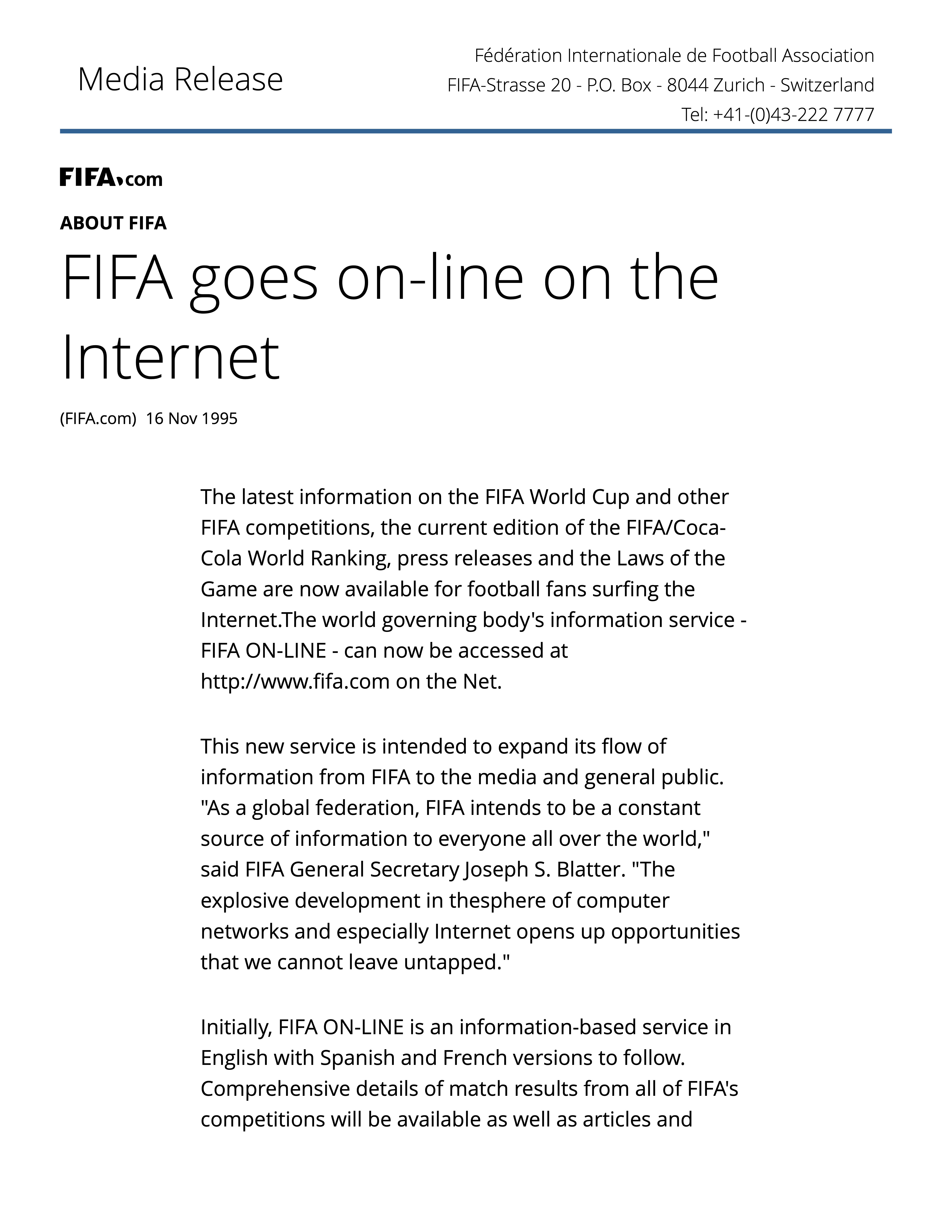
FIFA then authorized my company, En-Línea, to design, develop, and operate the official online platform. At first, we financed the project ourselves, convinced that the digital future of football had to begin, even if few people could yet see it.
On 16 November 1995, FIFA formally acknowledged the partnership, a milestone preserved in the historic press release that accompanies this anniversary.
The idea was simple but profound: Football should speak to the world with its own voice.
That idea became the seed of the digital transformation of global sport.
Building FIFA’s Internal Digital Capacity
Once the platform was running, FIFA began preparing internally to manage and expand this new digital era.
With our guidance, and under the leadership of Andreas Herren, FIFA began establishing its own technological capacity, including the creation of the first structured FIFA World Cup databases, an effort led by Marius Schneider and supported by earlier work from Luca Colajanni and Giorgio Farina from Italia ’90.
After the 1998 World Cup, FIFA created its first internal Technology Department, appointing Gérard Gouillou (the CTO of France ’98) as FIFA’s first Chief Technology Officer.
A new digital era had officially begun.
Legacy Consolidated
In late 2003, after nearly a decade of operational partnership, we transferred the operational and ownership rights of FIFA.com to FIFA, an act conceived as our contribution to world football and to the continued digital evolution of the institution.
Today, thirty years later, technology has become a strategic pillar within FIFA, and FIFA.com remains one of the most visited sports websites in the world, a central hub for fans, journalists, players, and federations everywhere.
Looking Back, and Ahead
It has now been three decades since that pioneering vision took shape during USA ’94, a vision that set football, and FIFA, on the path to becoming fully digital.
Football changed. Communication changed. The world changed.
And at the heart of that transformation, long before its impact was understood, stood a small, daring, visionary idea that became FIFA.com, marking the true beginning of the digital era for FIFA and the global game.